
Are small IT issues
constantly getting
in the way?
It’s usually not one big problem.
It’s the steady stream of small things that keep interrupting the day.
Something's slow.
Something doesn't load right.
Someone can't access what they need.
Nothing fully breaks, but nothing really works the way it should either.
And over time, it adds up.
Nothing urgent. Nothing broken. Just constant.
What this actually looks like during the day
The day starts with a plan. Then IT gets in the way.
- can’t access a system
- file missing or locked
- app lags or crashes
- work gets paused
- deadlines tighten

By mid-morning:
- Work is paused or retried
- Managers are fielding "is this fixed yet?"
- Tickets are in, but no one knows where they stand
By the afternoon:
- Another issue pops up
- Workarounds stack up
- Deadlines get tighter
The day ends with things "working again"
But no one expects that to last.
What we hear all the time
"It's not one big issue, it's just constant stuff."
"We're dealing with the same problems over and over."
"When something goes wrong, it turns into a fire drill."
"I don't really know if our IT is in good shape or not."
Most teams have simply gotten used to it.
What this is really costing you
This isn't just an IT problem.
It shows up in your business.
- Proposals go out late because files weren't accessible
- Follow-ups get missed because systems lag or don't update
- Clients notice delays
- Staff lose 30–60 minutes a day in small interruptions
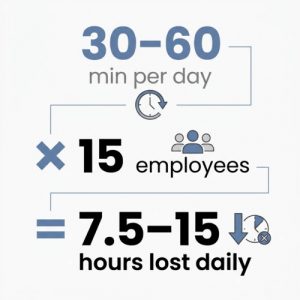
Across a 15-person team, that's one to two full workdays lost every day.
Most of it never shows up on a report.
You're not dealing with inconvenience. You're losing capacity every day.
The difference is control
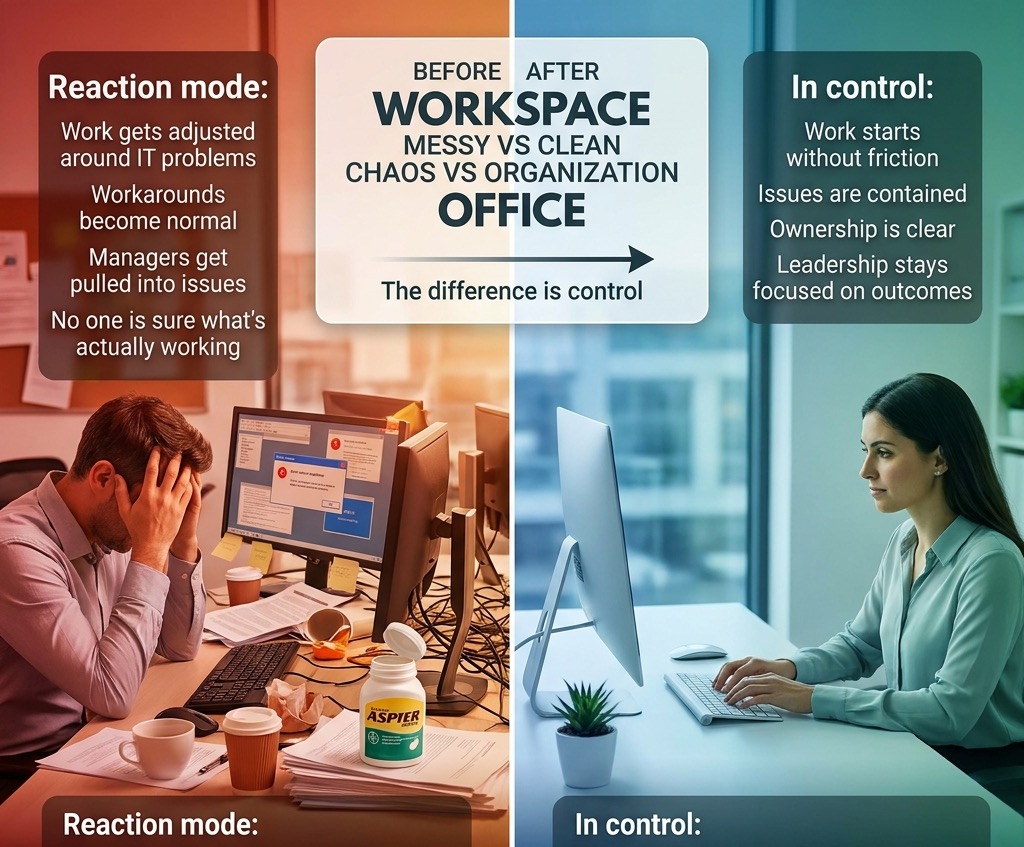
Same business. Same team.
The difference is whether your technology creates friction or removes it.
Most companies are not dealing with random issues. They are dealing with an environment that quietly forces them to react.
At some point, you need to step back and figure out why this keeps happening.
The IT Clarity & Control Review
It starts with a quick 15-minute conversation.
Step 1
Evaluation
If it makes sense to keep going, we schedule a 30-minute Closer Look review at a time most convenient for you.
Step 2
Closer Look
During our Closer Look review, we’ll ask about where issues are coming from, what is being handled versus what is assumed, and what is quietly creating friction or risk, and we'll complete a Level 1 Pentest.
Step 3
Findings Review
Then we walk you through what we found in plain language.
What you walk away with
- A clear picture of what's working and what isn't
- Where you're exposed
- Whether your data is actually protected
- Why issues keep repeating
- What matters to fix first
"This explains why we keep dealing with the same issues."

If someone in your office handles IT by default, this usually lands with them first
We take this seriously
If you go through the review and feel it wasn't worth your time,
we will donate $200 to the nonprofit of the month. No questions asked.
Who this is for
We work with teams across Oregon, including Portland, Salem, Albany, Eugene, Bend, and SW Washington.
This is a fit if:
- 10–150 employees
- Systems matter to daily operations
- You've outgrown reactive IT
- You're dealing with constant friction
Not a fit if:
- You are mainly looking for the lowest-cost option
- You only want break-fix (If it breaks, pay somebody to come fix it)
- IT isn't impacting your day-to-day
Start with a quick conversation
No pressure. No pitch.
Just a 15-minute call to talk through what's going on and decide if it makes sense to go further.
It's a 15-minute call. If it's not a fit, we'll tell you that.





Questions people usually have before booking
Is this going to turn into a sales pitch?
No. The first conversation is just that, a conversation. We'll talk through what's been coming up and whether it's even worth taking a closer look. If it's not, we'll tell you.
I'm not looking to switch providers right now. Does this still make sense?
Yes. Most of the teams we talk to already have someone in place. This isn't about switching, it's about understanding what's actually going on and whether anything is being missed.
What if this just tells me what I already know?
That's a fair concern, and it's exactly why we added the guarantee. If you go through the review and feel like you didn't get anything useful out of it, we'll donate $200 to a nonprofit of your choice. No questions asked.
How much time is this really going to take?
The first step is a 15-minute conversation. If it makes sense to continue, the review session is about an hour, followed by a walkthrough of what we found. No drawn-out process.
Is this going to create more work for me?
No. We don't expect you to gather a bunch of information ahead of time. We guide the process and ask for what we need along the way.
We've had someone look at our IT before and nothing really changed. What's different here?
Most reviews focus on tools and surface-level issues. We focus on patterns, what keeps coming back, where time is being lost, and what's actually being missed. That's usually where the difference shows up.
What happens if we go through this and don't want to move forward?
That's completely fine. You'll still leave with a clear understanding of where things stand and what needs attention. What you do with that is up to you.