The recovery plan is in a folder. Somebody wrote it in 2021. It names a phone system you replaced, a vendor you left, and two employees who no longer work there.
That is the usual state of a disaster recovery plan. Not missing. Stale.
The reason is almost never indifference. It is that the first version, and every rewrite since, starts with a blank page.
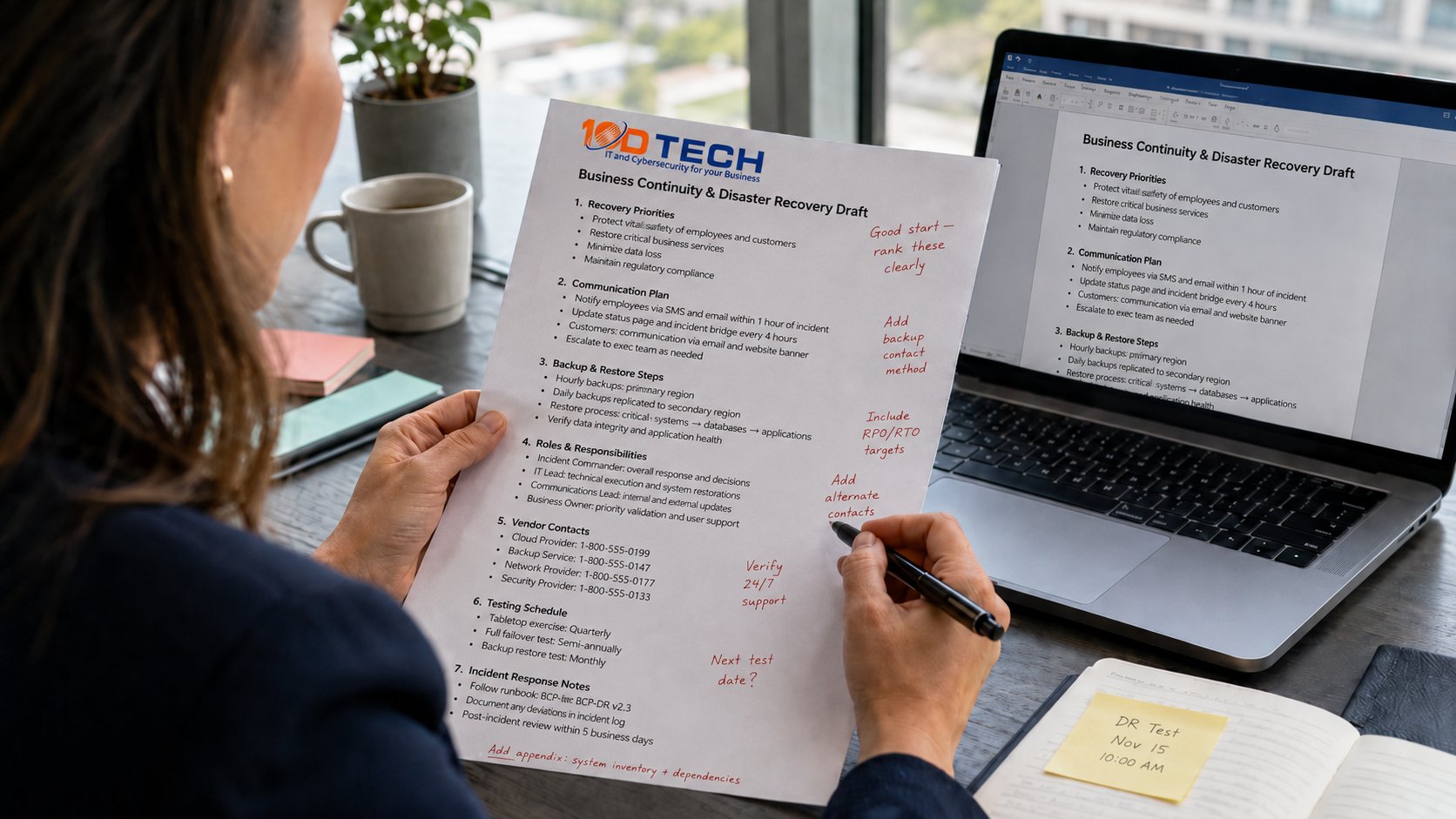
People are much better at fixing a draft than producing one. Hand a team something rough and they will tell you what is wrong with it in ten minutes. Hand them an empty document and it moves to next week.
That is where AI earns its place in preparedness work. Not as the plan. As the draft.
1. Get processes out of people's heads
The hardest part of documentation is not writing. It is extraction.
AI turns rough input into a structured first draft: https://www.ready.gov/September dictated notes, a meeting transcript, a list of bullets somebody typed in a hurry. How to restore access to the practice management system. Who gets called during an outage and in what order. What the front desk does when the phones are down.
https://www.10dtech.com/2026/09/02/15-minute-leadership-preparedness-meeting
The people who know the business still have to correct it. Correcting takes twenty minutes. Starting takes three weeks.
2. Turn the plan into checklists people can follow under pressure
A plan nobody can follow at two in the morning is a document rather than a plan.
AI drafts checklists and response outlines quickly. An outage communication sequence. A first hour response for a suspected breach. A continuity checklist for a location that becomes unavailable.
https://www.cisa.gov/resources-tools/resources/business-continuity-box
Then your team makes it real. Names instead of roles. Actual phone numbers. The steps that are specific to how you work.
3. Surface the questions nobody asked
The hardest part of recovery planning is not answering the questions. It is knowing which ones to ask.
This is where a model is genuinely useful, because it has read far more continuity planning material than anyone on your team has time to.
- What breaks if our internet is out for eight hours?
- What continuity risks are specific to a firm that bills hourly?
- What is typically missing from a small business continuity plan?
It will not know which of those matter most to you. It will put things on the table that your team can then rank.
4. Translate technical documents into decisions
Backup reports, security findings, and vendor summaries are written for technicians. They can be entirely accurate and still leave a leadership team unable to decide anything.
AI handles that translation well: what the document says, what it means for daily operations, and what to ask your IT provider about it.
The goal is not for every leader to understand every detail. It is for the right people to understand enough to decide what gets attention, what waits, and what does not wait.
5. Keep it current instead of rewriting it
Plans go stale in ordinary ways. A vendor changes. A tool gets replaced. Somebody leaves.
Refreshing is exactly the kind of work AI does well. Compare the old procedure against new notes. Standardize formatting across documents written years apart. Turn a list of changes into an updated draft.
A human still decides what is accurate and what is approved. That part does not transfer.
Where AI stops
Everything above is drafting, organizing, and prompting. The value ends at the point where something has to be true.
AI cannot:
- Test whether your backups restore
- Confirm your recovery timeline is achievable on your actual hardware and bandwidth
- Know how your systems depend on one another
- Coordinate your people during a live outage
- Carry accountability for a decision
Those five are the whole difference between a plan that reads well and a plan that works.
Where an IT partner fits
https://www.cisa.gov/cyber-guidance-small-businesses
A recovery plan can look complete and still fall over in the first hour. The gap is rarely the writing. It is that nothing in it was ever tested.
https://www.10dtech.com/services/data-backup-disaster-recovery
That is the work. Confirming the backups restore. Timing the restore on your actual systems. Mapping which system has to come up before another one will function. Walking the team through it once while nothing is on fire.
AI gets you the draft. Testing is what turns the draft into confidence.
Start with the draft
If your plan is stale or missing, use AI this week to get a first version onto paper. It will be imperfect, and it will be far easier to fix than a blank page.
Then find out whether it holds.
A complimentary 15 minute Technology Confidence Score call gives you a clear picture of where your systems stand today, along with your score out of 100. Schedule at 10dtech.com/Tech_Confidence_Score. Albany, Corvallis, Eugene, Bend: 541-243-4103. Portland, Salem: 971-915-9103.
Frequently Asked Questions
Can AI write a disaster recovery plan for my business?
It can write a draft. It cannot write your plan. A general model does not know your systems, your vendors, your recovery time requirements, or your compliance obligations unless you tell it, and it has no way to verify that anything it produced is true. Treat the output as a starting document your team edits, never as a finished plan.
What makes a response checklist usable during an actual outage?
Names and phone numbers rather than job titles, steps in the order they happen, and a copy that does not live only on the system that might be down. Print one. The most detailed continuity plan in the company is useless if it is stored in the file share you are trying to restore.
What information should never be pasted into a public AI tool?
Client data, employee records, credentials, network diagrams, and anything covered by a compliance obligation. If your organization uses a business tier tool with a data processing agreement, the rules are different, and somebody should confirm what that agreement actually says before the first sensitive document goes in. The safer habit for planning work is to describe the situation generically and add the specifics after the draft comes back. https://www.10dtech.com/services/managed-cybersecurity
What can AI not do in disaster recovery planning?
It cannot verify anything. It cannot test a restore, confirm a recovery time is realistic for your environment, or know how your systems depend on one another. It also cannot be accountable, which matters more than it sounds. A plan needs an owner who is answerable when it gets used.
How often should a disaster recovery plan be updated?
Once a year at minimum, and immediately after anything that changes the answers: a system replacement, a new location, a vendor change, or the departure of somebody named in the plan. A plan that names people who left is worse than no plan, because it creates confidence that is not warranted.